Cross-Stitch World
- 4.7
- Rating
- 1.00M
- Installs
- Free
- Price
 Analysis by App-foxy
I approached Cross-Stitch World expecting a quiet color-by-number pastime, and that is exactly where its appeal begins. This casual game from Inertia Software turns cross-stitching into a simple tap-and-fill activity: choose a pattern, identify the matching color, and gradually watch the picture take shape. It is easy to understand within moments, but the real question is whether the steady stream of patterns gives you enough reason to keep returning. After spending time with it, my answer is mostly yes, provided you enjoy calm repetition more than fast action or deep strategy.
The game is free to start and suitable for Everyone, which makes it approachable for children, adults, and anyone looking for a low-pressure distraction. Its store presence shows a 4.7 average from around 64 thousand ratings, and it has passed the million-install mark. Those figures do not replace personal experience, but they do fit the kind of broad appeal I felt while playing: there is no complicated setup, no demanding reflex test, and no need to learn a large rule set before the first satisfying result.
How the first goals become a reason to continue
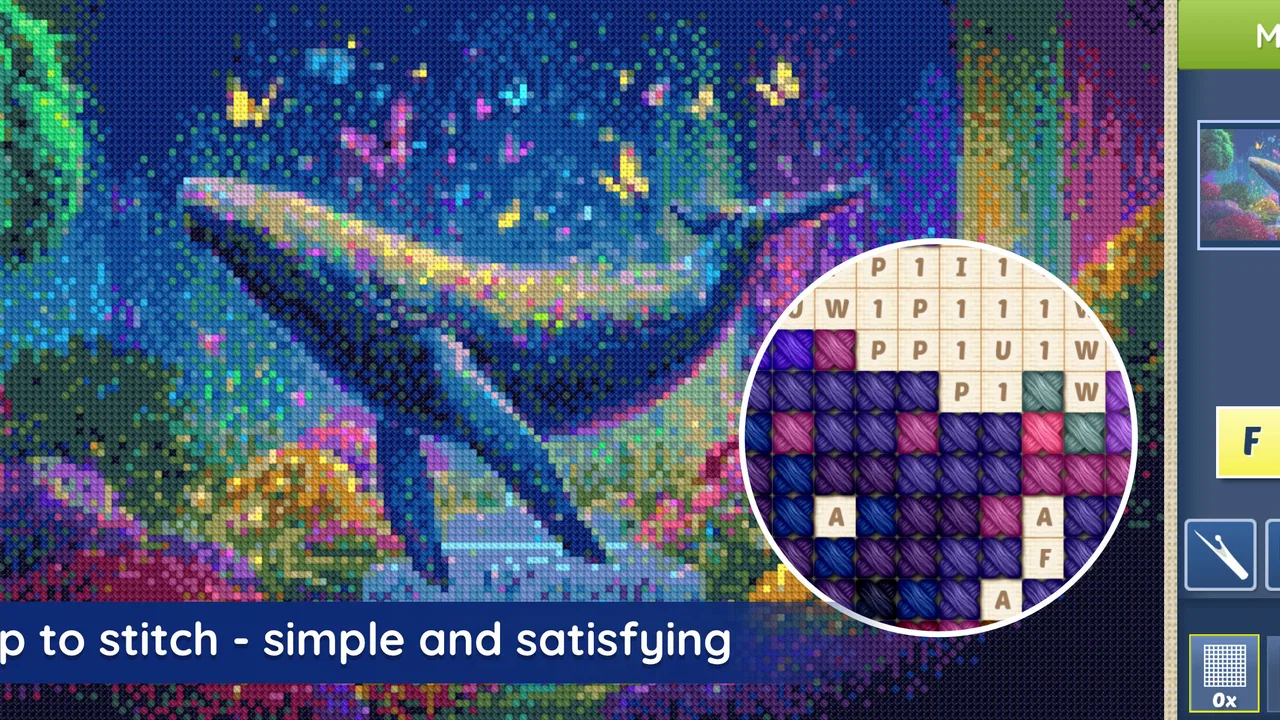
The opening objective is wonderfully clear: complete a picture. There is no need to wonder what success looks like. A partly finished design provides an immediate visual target, and every filled section makes the remaining work easier to read. I found that this creates a useful rhythm for short sessions. I could begin a pattern with the intention of playing for only a few minutes, finish a small area, and stop without feeling that I had abandoned an important task.
You May Also Like

 Google Keep - Notes and lists
Google Keep’s Quiet Growth Shows the Appeal of Simpler Notes
As mobile work gets busier, Google Keep keeps winning a simple contest: capture a thought quickly, find it later, and get on with the day.

 Blood Strike: 2.5 Anniversary
Blood Strike’s Loadouts Turn Every Drop Into a Tactical Gamble
A close look at Blood Strike’s custom loadouts: how fast access to signature weapons reshapes its battle royale rhythm, rewards preparation, and narrows the gap between fights.

 Pandora - Music & Podcasts
Pandora’s Music Is Easy to Start, but Harder to Recover
Pandora’s strength is its low-effort path from a seed to a station. Its weak spot is how much confidence it asks you to place in connection, setup, and quiet recovery.

 8 Ball Pool
 Is Built on Rivalries, Rematches, and Routine
A close look at the rivalries, rematches, shared routines, and unanswered safety questions that turn a quick pool match into a persistent mobile community.

 Samsung Music
’s Quiet Strength Is Playing What You Already Own
Its reach comes less from spectacle than from dependable access to a personal library. That simplicity is both the app’s strongest retention engine and its ceiling.

 AccuWeather: Weather Radar
AccuWeather Review: A Quick, Clear Forecast for Everyday Decisions
For everyday plans, the best forecast is the one you can understand quickly. AccuWeather makes rain timing, radar, and local conditions easy to act on, with a few trade-offs.
More From Our News Desk



That simplicity is also the game’s first limitation. Players who need a strong narrative, dramatic missions, or a character-driven reason to progress may find the initial goal too thin. The motivation comes from completion itself, not from a story or a competitive ladder. For me, that worked best when I treated each design as a small creative project rather than expecting a conventional game campaign.
The collection of available artwork gives the early experience more direction than a single repeating board would. With over 10,000 patterns to explore, the long-term promise is variety, even though the basic action remains familiar. I liked being able to choose a picture based on mood instead of being pushed through one fixed sequence. A bright design can suit a quick break, while a more detailed image gives me something to settle into when I want a longer, quieter session.
The option to create your own patterns is particularly important to the game’s identity. It changes the experience from simply consuming prepared pictures to making the activity personal. I would not recommend treating that feature as a requirement on the first launch, though. New players are better served by completing a few ready-made designs first, learning how colors and sections behave before investing time in their own visual ideas.
Small sessions work better than forced marathons
One of my favorite ways to use the game is during an ordinary waiting period: sitting with a coffee, taking a break between chores, or winding down before bed. Because the objective is visual and self-contained, I do not need to remember a complicated plot or rebuild a strategy after putting the phone down. That makes the game more forgiving than many puzzle alternatives, where stopping halfway through can leave me feeling mentally unfinished.
There is also a practical benefit to the clear visual feedback. When I complete a cluster of stitches, the image becomes more recognizable, which supplies a natural sense of progress even when the overall design is large. This is a stronger reward than a bare percentage counter because I can see the result changing. The picture itself acts as the progress signal.
My advice is to select patterns according to the amount of attention you actually have. A detailed image can be satisfying when you are relaxed, but it can feel slow if you are playing while distracted. A simpler design is a better choice for a short break. That sounds obvious, yet it makes a noticeable difference: the same tap-based mechanic feels either pleasantly meditative or mildly repetitive depending on whether the pattern matches the moment.
Progress signals, unlocks, and the shape of the collection
Cross-stitch games live or die by the feeling that each finished picture matters. Here, the completed artwork is the clearest signal. I can see a design move from incomplete to finished, and that visual transformation gives the session a beginning, middle, and end. The broader pattern library then provides the next target. This is a softer progression model than the level maps used by many casual puzzle games, but it suits the craft theme.
The game’s strongest progression idea is accumulation. Instead of chasing a single final victory, I build a personal history of completed designs. That approach is well suited to players who enjoy collecting finished work and browsing for the next appealing subject. It is less compelling for anyone who wants every session to introduce a new mechanic or a dramatically harder obstacle.
Creating patterns adds another kind of progress: improvement in taste and planning. A player can start by filling existing designs and later experiment with personal artwork. I see this as a useful second phase rather than an advanced competitive system. It gives experienced users a way to remain involved after the novelty of the prepared gallery has faded, while still keeping the central activity recognizable.
One trade-off is that visual completion can become less exciting once the basic interaction has lost its novelty. The game does not appear designed around constant surprises; its satisfaction comes from repetition with a visible result. If you need frequent unlock announcements, escalating abilities, or dramatic rewards, the pacing may feel restrained. If you enjoy watching a collection grow one finished image at a time, that restraint is part of the charm.
What to watch for when choosing a pattern
I recommend looking at the pattern as a workload, not only as a picture. A design with many small areas may be attractive but demand more patience than expected. Starting with something that offers clear blocks of color helps you learn the interface and understand how much attention a full design requires. Once the process feels comfortable, more intricate artwork becomes easier to appreciate rather than seeming like a wall of tiny tasks.
This also gives the game a useful self-directed challenge. The app does not need to tell me to improve my speed or accuracy; I can choose a more demanding image when I want a longer project. That flexibility is a strength for mixed audiences. A younger player can focus on recognizable pictures, while an adult looking for a concentration exercise can deliberately choose something more involved.
The downside is that player-created content can shift the experience away from the polished consistency of the prepared gallery. Designing something personal is rewarding, but it asks more of me than simply selecting a ready-made picture. I would use that feature when I want ownership and experimentation, not when I am looking for the fastest route to a finished image.
Difficulty and pacing: calm challenge rather than pressure
The difficulty curve is gentle because the fundamental task remains accessible. There is no need for quick reactions, and the activity does not punish me for taking time. The challenge comes from attention: locating the right areas, staying organized, and continuing through a pattern that may contain many small details. That makes the game suitable for relaxing play, but it also means the sense of difficulty depends heavily on the artwork I choose.
I appreciate that the game can be challenging without becoming stressful. When I make progress on a complicated image, the satisfaction comes from persistence and concentration rather than from surviving a failure state. This is a good fit for people who like puzzles but dislike countdowns, lives, or sudden difficulty spikes. It is also a reasonable option for a family setting because the Everyone rating reflects its broad, non-threatening presentation.
At the same time, players searching for a demanding logic test should adjust their expectations. Cross-Stitch World is not trying to replace a number puzzle, a word game, or a tactical board game. The decisions are limited, and the main skill is careful completion. I would choose another category if I wanted to exercise deduction or solve a problem with several competing routes.
The pacing works best when the game respects the player’s chosen tempo. A short session can still feel complete if I finish a small section, while a longer session allows the image to develop gradually. That flexibility is more valuable to me than an aggressive level structure. However, it can also make the game feel directionless for users who prefer a clear sequence of increasingly difficult stages.
Where the relaxed design creates friction
Repetition is the central trade-off. Filling one color after another is soothing at first, but the same action can become mechanical during a long sitting. I avoid that feeling by changing patterns rather than forcing myself to finish one picture in a single session. The ability to create a personal pattern can also refresh interest, but it does not transform the basic interaction into something entirely new.
The free entry point is welcome, yet the presence of in-app purchases ranging from $4.99 to $45.99 per item means some users will want to be careful around optional spending. I would approach the game with a clear personal limit and judge it by the free experience before buying anything. The purchase range is worth knowing in advance, especially for families sharing a device or for anyone who tends to spend impulsively in collection-focused games.
Another consideration is the age of the supported platform. The current version is 3.2.4 and requires Android 6.0 or later. That is helpful information for someone using an older phone or tablet, because compatibility should be checked before expecting a smooth installation. On a suitable device, the game’s straightforward presentation feels appropriately light rather than overloaded with demanding visual effects.
Retention pressure: why I return, and why I sometimes stop
The game encourages return visits through unfinished pictures, the attraction of a new design, and the satisfaction of expanding a completed collection. These are gentle forms of retention. I do not feel pushed by a story cliffhanger or a competitive ranking; I come back because a pattern is waiting and the activity fits a quiet moment.
That distinction matters. Some casual games retain players through daily pressure, limited attempts, or escalating rewards. Cross-Stitch World is more appealing when I want an optional hobby rather than another obligation on my phone. Its retention is strongest for people who enjoy routines they control: a few minutes today, a longer session later, and no need to maintain a perfect schedule.
The risk is that the collection can begin to feel like a checklist. Once I have completed several designs, the next picture needs to look personally interesting to justify starting it. Browsing therefore becomes part of the experience, and users who are selective about artwork may spend time choosing rather than stitching. I do not see that as a flaw by itself, but it explains why the game’s appeal can vary from one player to another even when everyone understands the same controls.
For an everyday example, I would use it during a commute only if I had a stable place to sit and enough attention for a pattern. It is less suitable while walking, multitasking, or dealing with frequent interruptions, because the pleasure depends on noticing small areas and maintaining visual focus. At home, it works well as a screen activity between more demanding tasks. I would not pick it for a party or group game night, where conversation and competition are usually more important than solitary concentration.
The absence of pressure is also why I would recommend it to someone trying to reduce frantic phone use. It gives the hands something to do without demanding rapid decisions. Still, it remains screen time, and the repetitive interaction may not feel restorative to everyone. If your idea of relaxation is listening to music, reading, or taking a walk, this game may simply replace one quiet activity with another rather than improve your routine.
My progression verdict
After looking at its goals, progress signals, difficulty, and reasons to return, I see Cross-Stitch World as a focused casual pastime rather than a conventional progression-heavy game. Its early goal is immediately understandable, its completed artwork provides a visible reward, and its large pattern library gives the activity room to last. The custom-pattern option adds personal ownership, which helps the experience feel less like an endless queue of identical boards.
I would recommend it to people who enjoy coloring, pixel-style filling, craft-inspired activities, or calm collection building. It is especially good for short, interruptible sessions and for players who want to choose their own level of concentration. The free starting point makes it easy to test that rhythm, while the broad age rating makes it a comfortable suggestion for a mixed household.
I would skip it if you need a strong story, competitive goals, meaningful tactical decisions, or a sharply rising challenge curve. I would also be cautious if repetitive tapping quickly loses its appeal or if optional purchases are likely to create temptation. A traditional puzzle game is a better choice for structured problem-solving, and a creative drawing app is better if making original artwork is your main objective rather than an occasional extension of the experience.
For me, the deciding strength is the way a finished picture communicates progress without demanding urgency. I can see what I have accomplished, leave when I want, and return to a new design when the mood is right. The best way to enjoy it is to treat each pattern as a small, self-chosen project, not as a race through an endless catalogue.
In the end, Inertia Software has made a game with a narrow purpose and a clear personality. It does not reinvent casual play, but it understands the appeal of slow visual completion. With its free price, Everyone rating, and broad selection of patterns, it is easy to try. Whether it becomes a lasting favorite depends on one honest question: do you find repeated, visible progress relaxing? If the answer is yes, this is a thoughtful little companion for quiet moments.
FAQs for Cross-Stitch World
01What is Cross-Stitch World?
Cross-Stitch World is a relaxing digital embroidery game in which you complete colorful patterns by placing virtual stitches on numbered or colored sections. It is designed for casual play, with a large selection of pictures and a simple tap-based interface. The experience focuses on creativity and relaxation rather than competition, making it suitable for short sessions or longer crafting breaks.
02How does the gameplay work in Cross-Stitch World?
The basic gameplay is easy to understand: choose a design, select a thread color, and tap the matching spaces on the pattern to fill them. As you progress, images become more detailed and may require closer attention to color symbols or small sections. The controls are generally accessible for beginners, although completing highly detailed pictures can take patience and concentration.
03Is Cross-Stitch World free to download and play?
Cross-Stitch World can generally be downloaded for free, but the free experience may include advertising, optional purchases, or limitations on certain content and resources. Depending on the version and platform, some designs or features may require in-app purchases. It is worth checking the store listing before downloading, especially if you prefer a completely ad-free experience or want access to the full pattern library.
04Can Cross-Stitch World be played offline?
Some parts of Cross-Stitch World may remain available without a constant internet connection, particularly designs that have already been downloaded or loaded on the device. However, an internet connection may be needed for advertisements, new patterns, account synchronization, updates, or in-app purchase verification. Offline availability can vary between Android and iOS versions, so users should test the game after installation if offline play is important.
05Is Cross-Stitch World suitable for children and beginners?
Cross-Stitch World is approachable for beginners because it uses straightforward tapping instead of requiring real embroidery skills. Children may also enjoy the colorful patterns, but parents should review the app’s age rating, advertising, privacy information, and possible in-app purchases before allowing unsupervised use. Very young players may need help with small details, while older children and adults can usually learn the mechanics quickly.
Pros
- Relaxing gameplay suitable for short or extended sessions.
- Large variety of patterns keeps the experience fresh.
- Simple controls make it accessible for beginners.
- Colorful artwork looks appealing on mobile screens.
- Progress is easy to follow as designs gradually fill in.
Cons
- Some patterns may feel repetitive after extended play.
- Small stitches can be difficult to select on compact screens.
- Advanced designs can require considerable time to complete.
- The interface may feel cluttered on older devices.
- Players seeking fast-paced action may find it too slow.

Cross-Stitch World
Gallery